Calculate your net salary as a cross-border commuter to Switzerland online

The free gross-to-net calculator for cross-border commuters to Switzerland who live in Germany. With a full calculation of all taxes in Germany and Switzerland!

Start the calculation now

Bild Start the calculation now
  • Calculates all taxes for Switzerland and Germany
  • Entirely online
  • Including the health insurance contribution
  • Completely free, result within minutes

How does the net salary calculation for cross-border commuters in Switzerland work?

At first glance, calculating the net salary for German cross-border commuters who work, or want to work, in Switzerland looks highly complex. Our net salary calculator is designed so that a few details are enough to give you a detailed and reliable overview of all salary deductions in Switzerland and Germany within minutes:

  • Enter your name and e-mail address and start the calculation
  • Receive a personalised link and start the net salary calculation online
  • Enter your gross monthly income, place of residence and tax class
  • Enter details of your personal status
  • State your cross-border commuter status
  • Receive the completed net salary calculation as a PDF by e-mail straight away

Calculate your net salary as a cross-border commuter online now

Online consultation request

Please provide your full phone number incl. country code, area code and telephone number Please note that without a correct phone number your inquiry cannot be processed.

  • Enter your first name, surname and e-mail address and start the calculation
  • Receive a personalised link and start the net salary calculation online
  • Receive your completed net salary calculation as a PDF by e-mail within minutes

Tips and tricks for cross-border commuters

Claim your commute in your tax return:

Depending on how far away your place of work in Switzerland is, you cover a fair number of kilometres every day. Do not forget to claim the daily commute in your German tax return.

The right bank for cross-border commuters:

Do not open the bank account you will often need as a commuter in Switzerland with just any bank. Take the time to compare the offers, because the fees vary considerably. Some banks are commuter-friendly; others do not count commuters among their target customers and charge correspondingly high fees.

Well insured in case of illness:

As a cross-border commuter you can choose whether to join a health insurer in Switzerland or stay insured in Germany. A combination of the two is also possible and very common. Look into this early, because once you take up your job in Switzerland you have only three months to decide. After that you are "compulsorily insured" at your place of work. You will find more information on the complex subject of health insurance here.

Saving tax as a cross-border commuter:

As a commuter you continue to pay your tax in Germany. A high salary can drive your tax bill up quickly. Take the opportunity to save a good deal of tax by taking out a direct insurance policy through your employer. That way you not only save tax but also provide for your old age at the same time. Contributions of up to around EUR 6,700 a year (as at 2020) can be claimed in full for tax purposes. You will find more information on the three-pillar system and retirement provision in Switzerland here.

Swiss tax rates for certain occupational groups:

One clause of the double taxation agreement between Switzerland and Germany can be very interesting for certain occupational groups: it states that commuters who, for professional reasons, cannot spend the night at their German residence on more than 60 days a year pay tax on their entire salary in Switzerland. That way you benefit from the considerably lower Swiss tax rates without having your official residence in Switzerland.

Frequently asked questions

  • You combine a comparatively high salary with a low cost of living.
  • Support for families is considerably more attractive in Germany, because Switzerland has no parental leave. After maternity leave, mothers return to work or, if they want to stay at home longer, have to give up their job and receive no financial support from the state whatsoever. As a father it is therefore advisable to work in Switzerland and earn well, but to live with the family in Germany. And if the mother worked in Germany before the birth, she benefits from state-supported parental leave.
  • Not to be overlooked is the Swiss pension system, which often puts considerably more money into your retirement pocket than the German one. The statutory Swiss pension can also be topped up through the employer with a direct insurance policy - which is even tax-deductible in Germany. After their working life, former cross-border commuters can enjoy a higher standard of living in Germany - provided they worked in Switzerland for a number of years.

To be able to work in Switzerland you need a cross-border commuter permit. It is your employer's job to apply for it at the responsible cantonal office in Switzerland. Commuters receive a G permit, which is valid for 5 years in the case of permanent employment.

Cross-border commuters are liable to tax at their place of residence, that is in Germany. Switzerland and Germany have a double taxation agreement in place. The Swiss employer does deduct 4.5 per cent withholding tax from your gross salary, but this can be credited in Germany. 

A high salary can be a reason to turn your back on Germany. In most cases the considerably higher German tax rates cannot compete with the more favourable Swiss ones, where the average rate is around 12 per cent. Single commuters in particular benefit from moving to Switzerland, because the tax advantages can be enormous. Once you have a family, the picture looks different.

Families with small children should think a move to Switzerland through carefully. The high cost of living eats into the tax savings. Childcare up to kindergarten age in particular is very expensive in Switzerland. On top of that, Switzerland has no parental leave and requires mothers to return to work after 14 weeks of maternity leave. 

Until you turn 20 you are legally entitled to 5 weeks of holiday, after that to 4. Some employers are generous and grant their staff 5 or more weeks a year even beyond the age of 20. Some Swiss employers also grant long-serving employees more holiday than the law provides for. 

Unemployment is unpleasant, but in Switzerland it is no cause for financial worry either, because you are insured. The condition is that you have worked in Switzerland for at least 6 months by then. You receive the benefits from the employment agency in Germany. Should you be dismissed, you must register as a jobseeker in person with the employment agency within three days in order to claim unemployment benefit. The Swiss unemployment fund issues form "PD U1", which you present to the employment agency in Germany as proof of your period of employment in Switzerland. If you are insured for health care in Switzerland, you must deregister there and join a German health insurer in Germany.


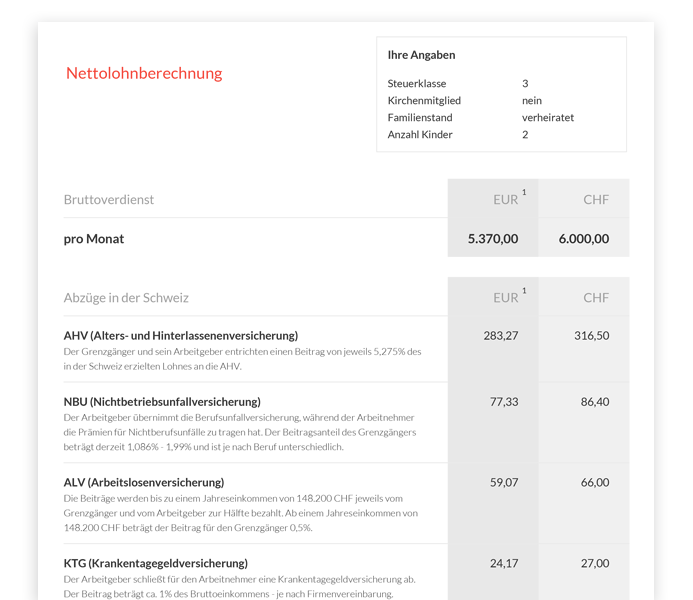
Example gross-to-net calculation
for a cross-border commuter to Switzerland

This example shows the net salary for a notional gross income of
CHF 6,500 a month with an employer in Switzerland. The employee is
married and has 2 children.

Deductions in Switzerland CHF
OASI (old-age and survivors' insurance)The commuter and their employer each pay a contribution of 5.275% of the salary earned in Switzerland into the OASI. 342,88
NBU (non-occupational accident insurance)The employer covers occupational accident insurance, while the employee bears the premiums for non-occupational accidents. The commuter's share is currently 1.086% - 1.99% and varies by occupation. 93,60
ALV (unemployment insurance)Up to an annual income of CHF 148,200 the contributions are shared equally between the commuter and the employer. Above CHF 148,200 a year the commuter's contribution is 0.5%. 71,50
KTG (daily sickness benefits insurance)The employer takes out daily sickness benefits insurance for the employee. The contribution is around 1% of gross income, depending on the company agreement. 29,25
Pension fundPension fund contributions vary according to age at entry, gender, the individual company contract and what is known as the coordinated salary. As a rule the contribution is shared equally between the commuter and the employer. 398,36
Withholding taxIn Switzerland the cross-border commuter pays a flat 4.5% withholding tax. 292,50
Total deductions in Switzerland 1.228,09
Deductions in Germany EUR
Income taxThe tax paid at the place of residence in Germany falls due quarterly in advance, on 10 March, 10 June, 10 September and 10 December. 871,43
Offsetting of withholding taxUnder the double taxation agreement, Germany deducts the 4.5% Swiss withholding tax already retained from the advance tax payments in Germany. -261,79
Health insurance (non-binding assumption)In principle there is an obligation to insure in Switzerland. There are, however, numerous exceptions - we work out the most favourable amount for you. 369,01
Total deductions in Germany 978,65

Your net salary in EUR approx.
3.739,71

  • CHF/EUR is converted at the tax office rate currently in force of EUR 0.895 (as at 2020)
  • Work-related expenses such as travel from home to the workplace are not taken into account

Please note that lohncomputer does not provide tax advice of any kind. Your net salary calculation is without obligation and may differ from your actual payslip.


Calculate your personal net salary now!

Work out your personal net salary as a cross-border commuter to Switzerland
in just a few minutes - entirely without obligation and, of course, free of charge.

Calculate your net salary now

powered by PORDEV. All rights reserved. Made with love in Cologne, Germany.